Stonephilia: Confessions of a Concrete-Loving Passive House Builder
A biophilic-design believer falls hard for polished concrete anyway — thermal mass, a skeptical wife, a curing-time mistake, and a shoutout to the Canadian company trying to make concrete less of a climate sin.
There’s a public library in my neighbourhood. Every time I walk in and sit down with a book, something in me exhales. I feel at home. Walk me into most other buildings, though, and I start eyeing the exit like it owes me money. Cold. Sterile. Get-me-out-of-here energy.
For a long time I just chalked this up to my own weirdness. Then I found the word for it: biophilia. Roughly, it’s our built-in pull toward nature — a craving to be near living things, even when we’re indoors. That library is finished almost entirely in mass timber, with exposed wood everywhere you look. The buildings that make me want to flee are, without fail, steel, concrete, or something aggressively man-made. Mystery solved. I wasn’t weird. I was just biophilic, like apparently most of us are.
Except then I fell for the stone anyway.
Here’s the plot twist: humanity is also completely obsessed with rock. Exterior brick. Stone fireplaces. Stone countertops. Polished concrete floors. We can’t stop touching the stuff. Look at the megalithic record if you want proof — the pyramids of Giza, Stonehenge, Machu Picchu, Göbekli Tepe. Ancient people lived inside airtight stone structures, walls thick enough to hold a steady indoor temperature no matter what was happening outside, and those structures are still standing thousands of years later, still gorgeous. Wood rots. Steel rusts. Stone just sits there looking smug for millennia. So maybe biophilia has a weird cousin — call it “stonephilia” — a love for rock that’s just as hardwired as our love for trees.
I’ve got a full-blown case of it. Specifically, I’m obsessed with “salt and pepper” polished concrete. Quick primer, for anyone who thought polished concrete was just one grey slab: there are three grades. Creamy is a light grind, one even colour throughout. Salt and pepper is a heavier grind that exposes the edges of the aggregate — the look I wanted. Full aggregate exposes a big chunk of the gravel itself, for a busier, more marbled finish.
But the real reason I wanted it wasn’t the look. It was physics. My ADU has two big south-facing windows, and my plan is simple: let the winter sun pour in, let the concrete floor soak it up like a sponge, and let it slowly release that heat back into the room overnight. Stone is an excellent thermal battery — it holds heat for a long time and gives it back slowly. That’s the whole bet. Whether the bet pays off in real life, I’ll find out soon, once the ADU is finished and winter shows up to test my theory.
Three things I learned the hard way (one of them embarrassing)
1. My wife is not biophilic about industrial flooring, and she’s the boss of interiors. She hated the idea from day one. To her, polished concrete meant big-box stores and parking garages, because that’s the only place she’d ever seen it. She’s not someone who wants her house to make a statement — she wants it to feel like a home, not a showroom. I made my case. Then I made it again. And again, gently, repeatedly, in the way that separates “persistent” from “annoying” by a margin of maybe one more conversation than she’d have liked. Eventually I got the yes. I count this as one of my proudest achievements in applied patience.
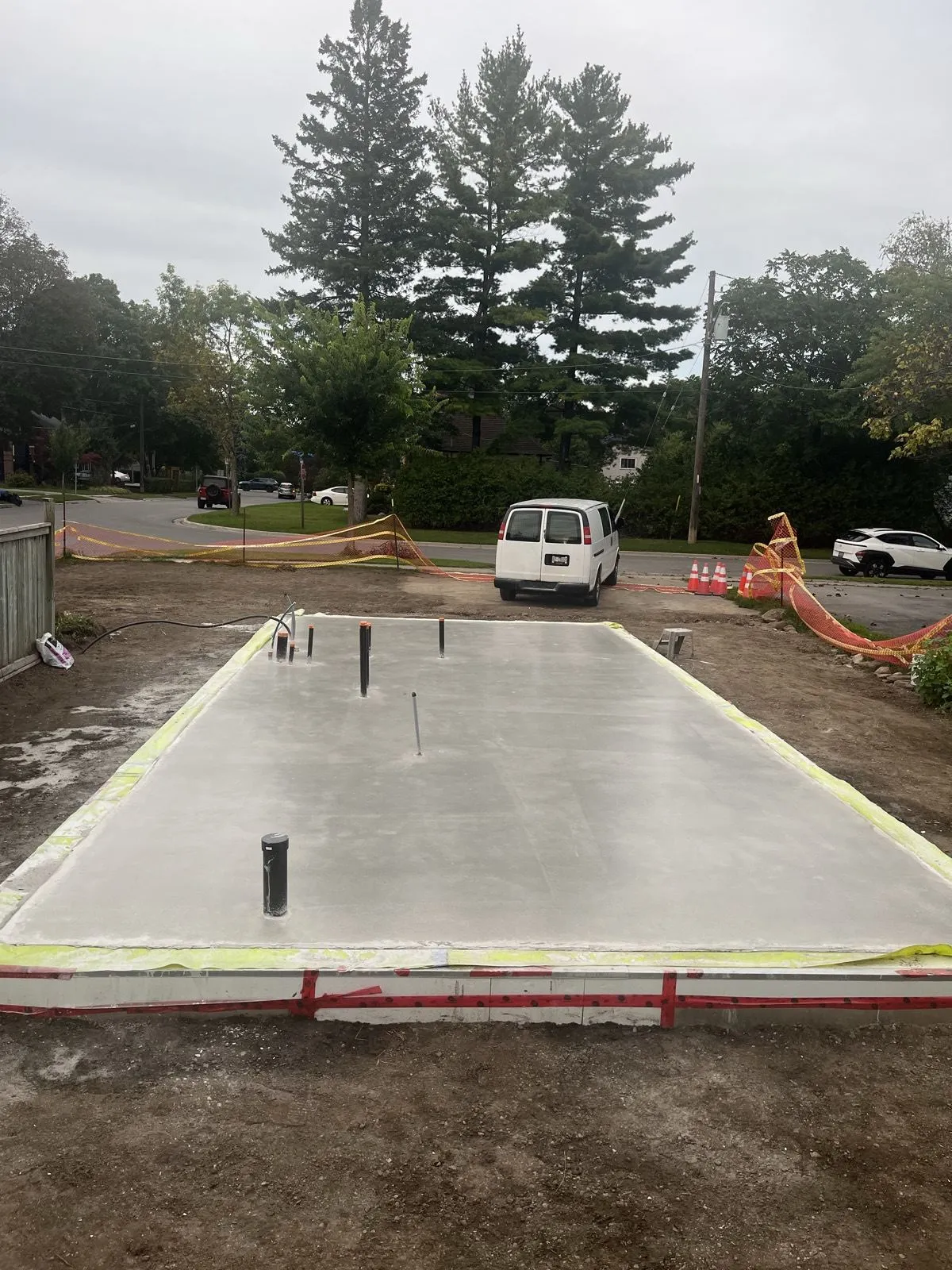
2. Nobody wants to polish 600 square feet. Turns out most Ontario polished-concrete companies live and breathe big commercial and industrial floors — warehouses, retail flagships, the kind of job where 600 square feet is a rounding error, not a contract. I called around ten companies before I found one willing to take on a project the size of a large living room. They did a beautiful job. The salt-and-pepper finish turned out exactly the way I’d hoped. But if you’re doing this on a small residential scale, budget real time for the hunt.
3. Never store anything on curing concrete unless you want a permanent Easter egg. Here’s my mistake. After the pour, concrete needs about a month to cure. During that window I also needed to get perimeter insulation installed and the site backfilled — but my excavator was tied up elsewhere, so I waited. While I waited, I laid my 4x8 sheets of insulation flat on top of the curing slab, just to get them out of the way.
Big mistake. Those sheets left faint, permanent rectangles on the finished floor — a subtle colour difference between the bare concrete and the spots that had insulation sitting on top. You have to really go looking for it, but once you see it, you can’t unsee it: a ghost grid of 4x8 rectangles, a monument to my own impatience. Lesson for anyone attempting this: if you want a uniform finish, keep absolutely everything off the slab while it cures — randomly, “temporarily,” or otherwise.
The original sin, and one company trying to make amends
Here’s the part where my love affair with concrete gets complicated. Concrete is an environmental original sin. Depending on which report you read, it’s responsible for something like 8% of global greenhouse gas emissions, according to the U.S. Department of Energy — putting cement production in the same emissions league as entire countries. Every time I admire my salt-and-pepper floor, I’m also standing on a small monument to industrial carbon output. Loving stone doesn’t cancel that out.
So it’s worth knowing that some people are actually working the problem. CarbonCure Technologies, a Halifax, Nova Scotia company, has developed a way to inject captured CO2 directly into concrete during mixing, where it mineralizes permanently — locked into the slab instead of drifting into the atmosphere — while also letting producers use less cement overall. It’s not a full pardon for concrete’s sins, but it’s the kind of practical, unglamorous innovation this industry badly needs.
Until concrete fully cleans up its act, I’ll keep using it where it earns its keep — thermal mass under south-facing glass, not decoration for decoration’s sake — and stay mindful of what it costs the planet every time I reach for it.